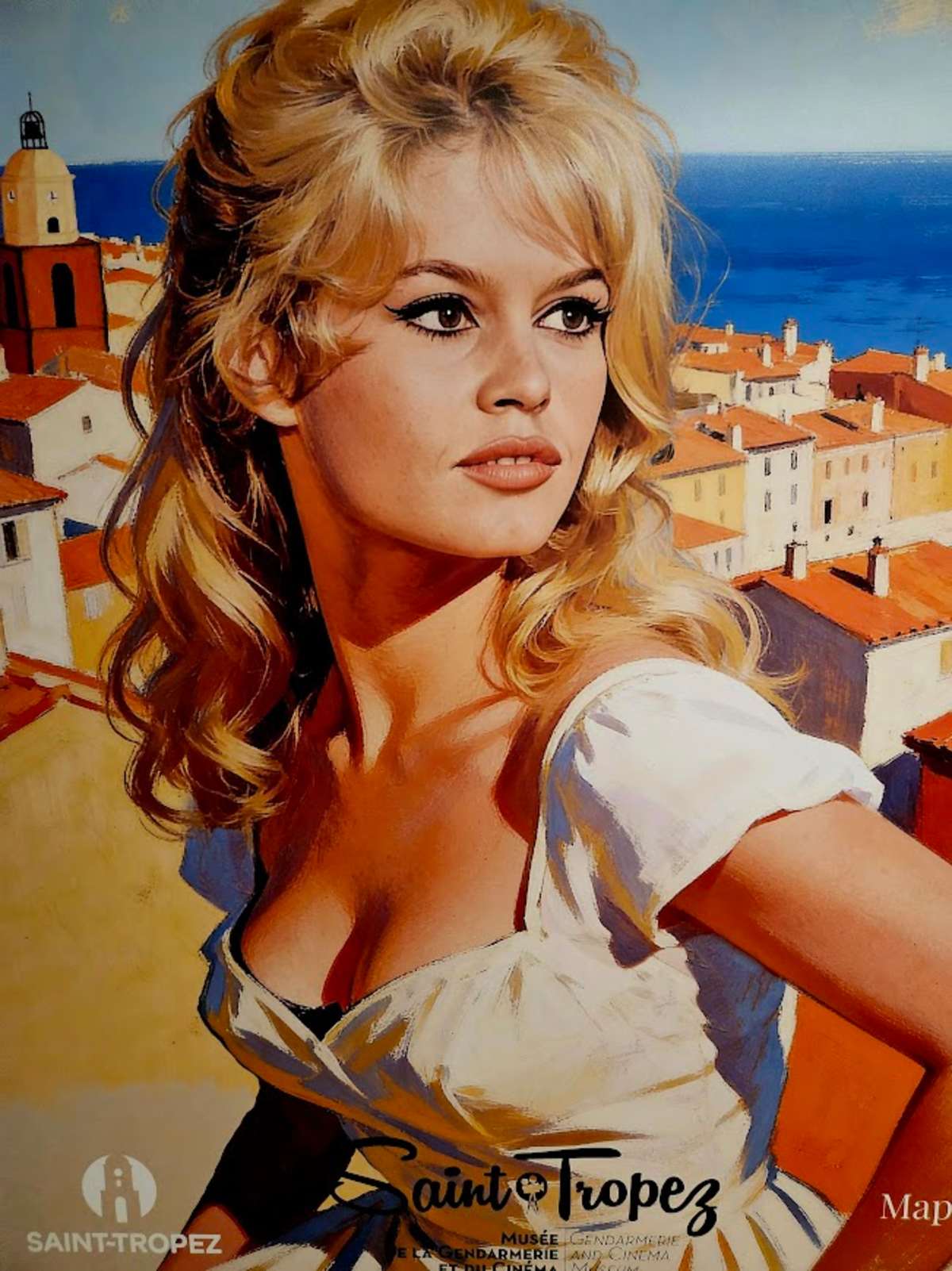
If you are not familiar with it, this is the 1956 film that not only put on the international map Saint-Tropez, until then a Mediterranean fishing village, but it also created the international phenomenon that is Brigitte Bardot.
Seventy years later, Bardot is everywhere in Saint-Tropez. She lived here until her death in December 2025 at the age of ninety-one.
The elderly Bardot, the hard-right conservative, anti-Muslim animal activist, is not mentioned. Instead, BB, the youthful symbol of the sexual revolution is celebrated everywhere—in shop windows, on magazine covers, posters, photos, fashionable T-shirts and handbags.
She is a Venus in gold curled on a half-shell in front of the Gendarmerie, created by the Italian comic book artist Milo Manara with a nod to Botticelli. A new exhibition devoted to her and And God Created Woman, recounts how the young screenwriter Roger Vadim came to direct his first film with his twenty-two-year-old wife as its star.
Vadim based his screenplay on a news item about a woman who was the mistress of three different brothers and ended up killing one of them. The woman became the seductive Juliette, a free-spirited girl in Saint-Tropez who lives and loves and plays with the affections of three brothers and a suave older millionaire played by the German-Austrian actor, Curd Jergens.
Movie-making life imitated art when Bardot fell in love with one of the brothers, played by Jean-Louis Trintignant. Their affair effectively ended her marriage to Vadim. Shot in widescreen and color, unusual for a French film of the time, And God Created Woman became a worldwide success and overnight turned Bardot into the symbol of freedom and sexuality she never escaped.
The exhibit argues that And God Created Woman was the precursor to what became in the 1960s the French Nouvelle Vague or New Wave of cinema. It opened the way for such auteurs as Jean-Luc Godard and Francois Truffaut.
None of Vadim’s other films had the same impact. What was racy and groundbreaking in 1956, now looks kind of silly and embarrassingly amateurish. For those reasons it is difficult to regard Vadim as one of the fathers of modern French cinema. One cannot simply say he is all but forgotten—he is plain forgotten.
Bardot never left France and had no interest in Hollywood. An enduring icon known around the world, the eternal BB, yet ironically most people have never seen any of the forty-seven movies she made before retiring in 1973.
She is buried with her parents and grandparents at Cimetière Marin de Saint Tropez, bordering the Mediterranean. Her grave is not hard to find. It overflows with flowers and photographs as well as stuffed toy seals in memory of her campaign to end the slaughter of seal pups in Northern Newfoundland. She receives a constant flow of visitors.
Not far away is the man who made her famous. Roger Vadim died in 2000 at the age of seventy-two. All five of his wives, including Bardot and Jane Fonda, attended his funeral.
You eventually find him by accident after a long search. A few stones adorn the top of his burial vault. A single word is etched in gold lettering: Vadim.
There are no visitors.