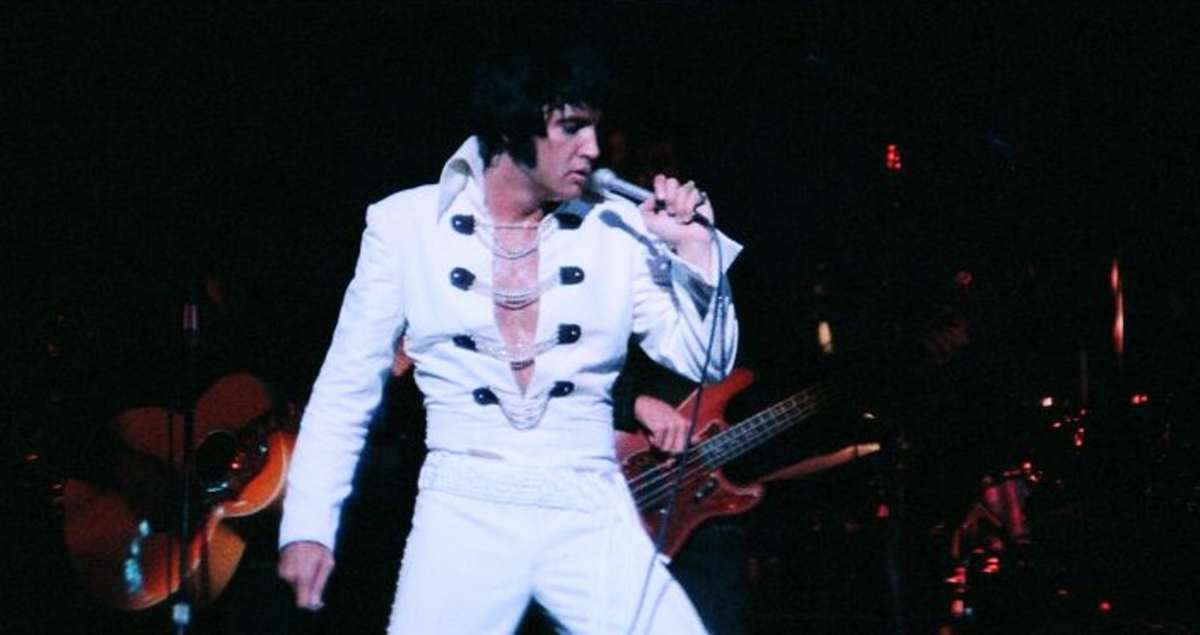
The first of the three times I saw Elvis Presley in concert it was Friday, September 1l, 1970. He played to a crowd of seventeen thousand at Detroit’s Olympia Stadium. I know this thanks to my very old and dear pal Ray Bennett, who was with me that night and who carefully records and remembers such things. The memory of that concert forms part of Ray’s soon-to-be published memoir, Mystery Train to Hollywood. In the book, he writes that we paid the princely sum of ten dollars each for our tickets.
Detroit was one of the stops on Elvis’s first concert tour since 1958 when the draft stopped dead the phenomenon he had created overnight. Until then, the only way most of us fans could see him was on a movie screen in blazing Technicolor in those mostly excruciating movies he made in Hollywood. Seeing him in person was a spellbinding experience. For forty-five minutes he put on an electrifying show, complete with relentlessly screaming fans—Ray and I restrained ourselves when it came to screaming. Fifty-six years later, we are still friends and we still talk about the night we first saw Elvis.
A mere seven years after that concert, we both also vividly remember where we were when we heard the news of Elvis’s death at the age of forty-two. Ray happened to be staying with me in Toronto on Sept. 11, 1977. Sadly, it was also the day Ray learned that his mother had died.
These memories and more came pouring back over the weekend after seeing Australian filmmaker Baz Luhrmann’s EPIC: Elvis Presley In Concert. The documentary—Luhrmann calls it the ultimate Elvis concert movie—puts the lie to the criticism back then that performing in Las Vegas diminished the king. Using lots of previously unseen and meticulously restored footage, Luhrmann presents the case for an even better Elvis in Vegas and on tour, even more magnetic and powerful than he had been in the 1950s. And that underrated baritone voice with its extraordinary range, never sounded better.
I saw Elvis for the last time in Buffalo a few years before his death. Amid reports about lackadaisical performances, forgetting lyrics, rambling on, I wondered what we were in for. He turned out to be great that afternoon, maybe a little slower and heavier, but still Elvis, very much attuned to his audience, even stopping to make sure an overexuberant fan was okay.
When he died at the age of forty-two, it was a shock of disbelief heard around the world. I found myself in tears. I actually thought of trying to somehow get to Memphis for his funeral. I pulled myself together and never went. I ran into my friend Earl McRae, a terrific journalist, gone now, and a fellow dedicated Elvis fan. I told him about how ridiculous I felt even fleetingly considering going to Memphis. “Don’t feel bad,” Earl said. “I went out to the airport and tried to get on a plane.”
In 1994, my soon-to-be wife, Kathy, and I were driving from Los Angeles to Toronto where we would start a new life together. In those days, you navigated across America with a map. Kathy had three of them open on her lap. We were driving through Tennessee when she looked up from her maps and said, “We’re passing Memphis. Let’s stop at Graceland.”
And we did. You could love a woman like that for a lifetime. And I have.
This past weekend we were with Elvis once again. I left the theatre a little sad, filled with bittersweet memories, buoyed by Luhrmann’s lovingly reimagined portrait. “Elvis ate America before America ate him,” U2’s Bono says in his ode to Elvis at the end of the movie. There was never anyone like him before, and there hasn’t been anyone like him since.
For Baz Luhrmann—and me—Elvis never left the building.