Recently, I was part of the virtual writing workshops sponsored annually by the Eden Mills Writers Festival. My task was to impart what wisdom I’ve managed to gather having written thirty novels, including, most recently five Priscilla Tempest Mysteries. Lots has been written on the subject, but having shared some of my experiences, good and bad, at the Eden Mills Writers workshop, I thought it might be useful for would-be authors to reprint a few of my thoughts. More to follow...
3. CONFLICT, DAMN YOU!
Conflict is the essence of mystery novels, of any novels when it comes down to it. Conflict drives the plot, creates the urge in the reader to find out what will happen next. Yet curiously enough, conflict is the is so often missing in the manuscripts I’m asked to read. The late Sol Stein, a legendary figure in American publishing, an editor and novelist who wrote several excellent books on writing, voiced the same complaint. He wrote: “In the manuscripts that come my way, the fault is seldom too much conflict.” He was continually amazed that he encountered what he called “non adversarial, static events that can change a page-turner into a ho-hummer.”
The last thing we want is a ho-hummer.
You would think novice writers would work overtime to ensure their stories didn’t put themselves to sleep, let alone the poor reader. But that is often not the case. Part of this absence of conflict, I would argue, has to do with the times in which we live. We are not fighting wars, no one cares who you marry, and for most of us the problems of everyday life, paying bills, keeping a job, getting kids through school are certainly important, but not gripping conflicts. But drop a dead body into that contemporary mix and suddenly you have conflict. All those other problems of modern-day life, become subplots. It’s no wonder even serious literary authors are drawn to the genre.
Conflict works even better if you set your mystery in another more restricted time. In the Priscilla Tempest mysteries, for example, the conflict is built in on several levels. There is the conflict that arises out of the fact that Priscilla is one of the few women working at the ultra-posh Savoy Hotel. What’s more her boss believes she disrupts the hotel’s carefully orchestrated routines and doesn’t want her there; a traditional British establishment fights to hold onto its power in a roiling sea of social change; and, oh yeah, a murder occurs that no one wants our plucky heroine to get to the bottom of. There is very little difficulty keeping the conflict going in these novels.
An earlier series, the Sanibel Sunset Detective Mysteries, on the other hand, take place in a contemporary setting on Sanibel Island, a barrier island off the west coast of Florida. Our hero is a private detective, Tree Callister. Tree is a former newspaperman who has no experience as a private detective. Everyone thinks he’s crazy to be a detective for starters, and then he is living on Sanibel where, as he keeps being told, nothing ever happens. What’s more, the local cops don’t like him and constantly get in his way. With the conflict already baked into the novels, I then drop a dead body or two around Sanibel just to keep things interesting.
4. LOCATON, LOCATION, LOCATION
As you sit at your keyboard about to enter your world of mystery, where is it? Where will your mystery unfold?
Setting!
It’s almost as important as conflict when it comes to writing a mystery. Your setting, as has been pointed out many times, should be a character in your book. After all, you are going to be spending a lot of time there. But where? The tiny English village where nothing happens but murder. New York? Los Angeles, Paris, Rome? Places where murder is all too common, thanks to far-too-many authors using those settings, possibly in order to expense family vacations. Not that I’ve ever done that, of course.
My brother Ric introduced me to Sanibel Island, and suggested I set a novel there. I thought, aha, I had found a unique location for a series of private detective mysteries only to discover that it had already been inhabited by author Randy Wayne White whose series of Doc Ford mysteries were not only New York Times bestsellers, but had even inspired a couple of Doc Ford restaurants. Undaunted, I ploughed ahead. Doc Ford knows everything there is to know about that part of Florida. My character, Tree Callister, a newcomer, knows next to nothing. Tree’s inexperience works as built-in conflict. No one ever thinks he can solve the mystery and stay alive—more conflict—but Tree always fools everyone, even himself.
Similarly, thanks to my co-author and dear friend, Prudence Emery—hmmm, I do rely on others for these settings, don’t I?—I found myself at the iconic Savoy Hotel in London. Pru and I thought we had come up with a unique setting for our first collaboration, aided by Pru having actually worked at the Savoy in the late 1960s during the period in which the novels are set. Not only did we find that lots of books had been written about the hotel, both fiction and non-fiction, but a novel titled Murder at the Savoy was about to be published—the same title as our first book. Our title was quickly changed to Death at the Savoy and on we went. Pru’s firsthand experience at the hotel coupled with the 1960s time period in which the novels take place, set the novels apart from the competition—well, that’s what we told ourselves, anyway.
Interestingly—and perhaps there is a lesson here— I found a unique setting for a mystery in my own backyard—Milton, Ontario. I wrote four novels—The Milton Mysteries—based around a town that as far as I can tell no one else has written about. What’s more, it’s a fascinating area to set a mystery in. It is an intriguing stew of furious growth, influxes of immigrants, a controversial gravel industry hidden behind masses of green foliage, a landscape fraught with environmental issues created by the presence of the Niagara Escarpment with its high cliffs, perfect for pushing someone off of—in fiction, that is.
The point being, you may find your unique setting a few steps from your door. Whatever you decide, make it your own. The novelist John Banville notes that although Raymond Chandler is considered the last word on the mean streets of Los Angeles in the 1930s, “He invented Los Angeles…my Los Angeles is a Los Angeles from inside of my head…” Which is precisely where we should all reside when it comes to creating you novel’s setting. Chandler, in fact, made up most of the locations he writes about in The Big Sleep, the novel that made him famous and is considered to this day his masterpiece of hard-boiled detective fiction.
The Savoy Hotel certainly existed in 1968, and Pru did a wonderful job of helping to bring it to life with fascinating details drawn from her experiences, but ultimately we created our own version of the hotel in that period, much more romantic, much more dangerous than the actual place. In reality, there has been only one murder at the Savoy, in 1923—which I write about in the next novel—but at our Savoy there are two murders in the first novel alone.
5. ACTION IS CHARACTER!
We have established a place, now let’s find out about who will live it.
Your characters!
Action is character, F. Scott Fitzgerald by way of Aristotle by way of every screenwriting book ever written is one way to think of your central character. The actions of your protagonist overcoming hurdle after hurdle, conflict again, in pursuit of—well, it’s usually the killer in these books— brings the character to life. The importance of dialogue in revealing character also comes in here. Remember, in a novel, everything is larger and more dramatic, and this is certainly true of the characters you create. As Sol Stein observes, “Readers don’t want to pay money in order to spend twelve hours in the company of someone who is just like their neighbour next door.” That’s also true when it comes to dialogue. No one speaks in a novel the way you do in real life. Dialogue should be full of tension that reveals character and keeps the reader interested.
The novelist Jennifer Eagan points out, correctly, that novels are distinctive in that they are the only art form that takes you into the head of a character. Film and theatre can’t do that. This ability is particularly useful in mysteries. You enter the mind of the protagonist as he or she mulls over clues or attempts to deal with the dangers being faced. I use this device more with the Priscilla Tempest mysteries than I have previously, but I still prefer the action-is-character template to keep things moving. In The Maltese Falcon, for example, a second thought never enters Sam Spade’s head and it is considered the ground-breaking American mystery. Also, Elmore Leonard uses dialogue artfully—dialogue heavy, in fact—to drive character and plot.
This discussion of character takes us to the subject of point of view—POV. How are you going to tell the story you are creating? Will you use the omnipotent third person? You are the god manipulating your characters on the end of the strings that you are pulling. Or are you going to tell the story in the first person from the protagonist’s point of view? There is also a third option—tell the story in the third person, but only from your hero’s point of view. I have done this with Priscilla in the last couple of novels. It is constraining at times, but it keeps the focus on her so that the reader accompanies her as she gets to the bottom of the mystery.
For years everyone who wrote about writing a novel, warned about the first person, for reasons I never quite understood. Whatever the former prejudice about the first person, it seems to have disappeared. The first person narrative has become quite common. Personally, I still prefer the old-fashioned third person; it’s solid and reliable, and makes sense if you’re changing the point of view among a number of characters. Also, when it comes to the present tense in the unfolding of a mystery or the traditional past tense, call me a traditionalist; for whatever reason, I’m uneasy with the present tense, even as a reader, although it has become exceedingly popular.
6. THERE IS ONLY ONE PLOT
Two pieces of advice about plot I’ve always found helpful. The gospel according to the noir novelist Jim Thompson: “There is only one plot: Nothing is as it seems. From spy novelist, John Le Carré: “The cat on the cat’s mat is not a story. The cat on the dog’s mat is a story.”
Stephen King, who, let’s face it, knows something about such matters, says he never writes plot. He writes characters who somehow fold themselves into a story, although he does admit that for a recent novel, a detective mystery, he concentrated more on plot. Considering that everyone fights to turn King’s novels and stories into film in a way that no other contemporary author experiences, and given that film by necessity is plot-based, his assertion is somewhat hard to swallow.
I would say this about plot: let it unfold. Enter your world and see what happens. Assuming you are writing a mystery, somewhere along the way, a dead body will show up. That in itself propels the plot forward. When a murder occurs, the novel’s protagonist(s) must set about solving it.
For me, that’s where the fun of plotting comes in, you are in this other world, a murder has occurred, you have no idea what happens next…I wouldn’t write an outline, let the plot unfold. Don’t worry if you can’t immediately figure out what happens next, it will come. The plot will follow you around everywhere; you will think about it as you fall asleep because as you drift off you are back in the world you created. You will dream in that world. Don’t worry, it will all work out. The job is to keep yourself entertained, keep twisting that plot around, keep yourself constantly surprised. If you are not bored with what you’re writing, the reader won’t be either.
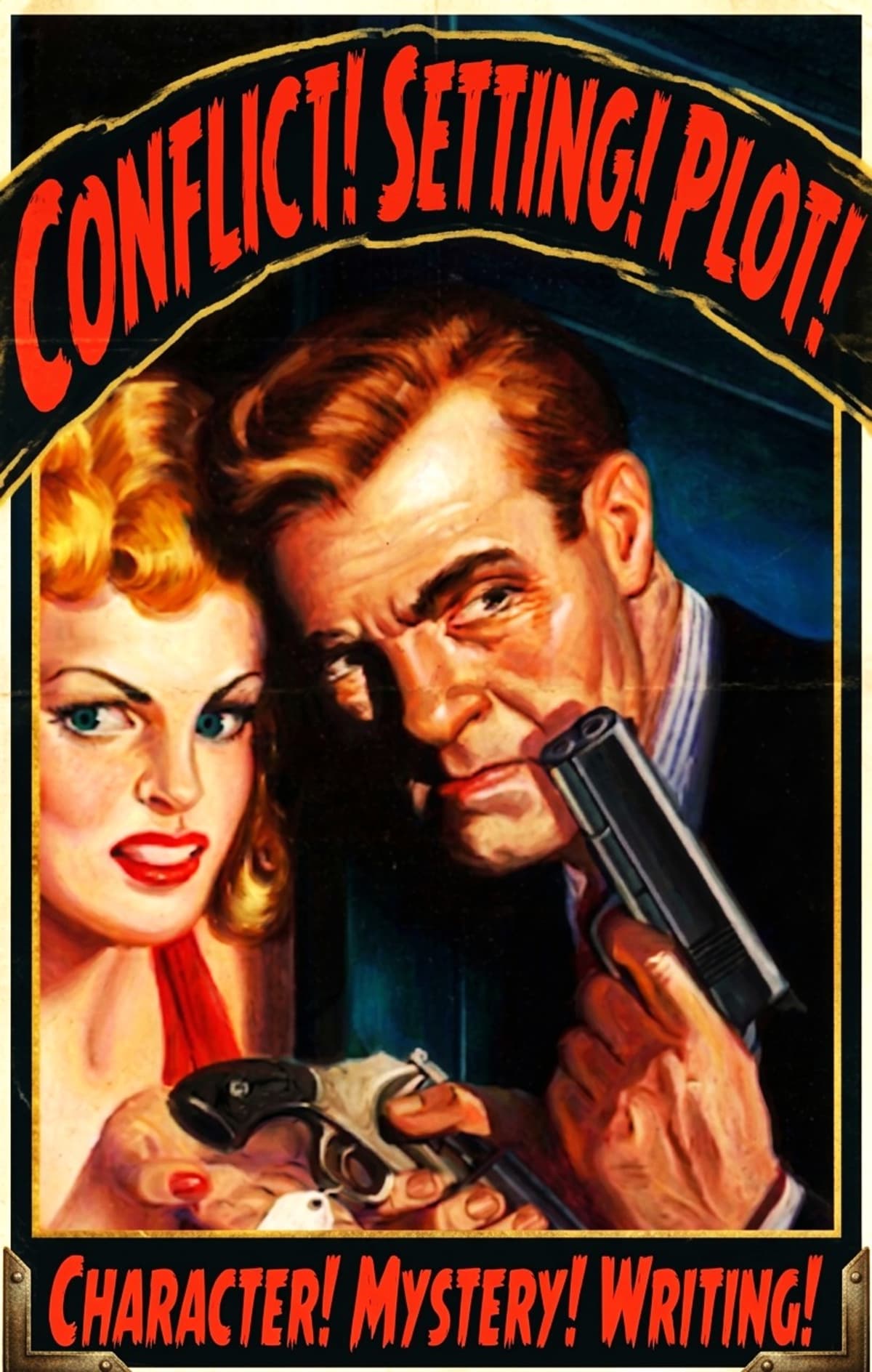
If you are having trouble deciding what comes next, take this advice from Raymond Chandler: “If you don’t know what to do, have somebody come through the door with a gun.”
It works! I’ve used it—on more than one occasion. This is the type of novel you are writing, you can get away with it. Be preposterous. Be outlandish. Swing for the fences. It’s a mystery novel. It’s larger than life.